By Andrew Chetley, New Internationalist Issue 272, 1995
Andrew Chetley looks at the crazy world of the drug industry.

The global pharmaceutical industry's annual sales amounted to $256 billion in 1994.1 That's more than the total health expenditure of all 'developing' countries plus the former socialist economies of Europe ($219.3 billion). 2 Inevitably the rich world controls the major chunk of this trade.
Glaxo Wellcome is kingpin with estimated annual sales of $14 billion. 3 It makes the world's best-selling drug - Zantac, an anti-ulcer treatment - which earns it $3.6 billion, more than the entire Gross National Product of countries like Nepal or Jamaica. 4
Research - cure or profit?
Total world spending on research and development of new drugs was estimated at 14.6 per cent of sales in 1990. But most of this money went on the development of drugs - the saleable items - and less than a tenth was devoted to pure research.
Most of this research produces 'me-too' drugs - add-ons to existing preparations rather than innovative products which are expensive and risky to develop.
 A seven-year survey of 'new' drugs by the US Food and Drug Administration found
that 3 per cent made an 'important potential contribution to existing
therapies'; 13 per cent made a 'modest potential contribution' and 84 per cent
made 'little or no potential contribution'. Most drugs are developed in the
West. Less than four per cent of research money goes to finding treatments for
diseases prevalent in the Majority World where three-quarters of the world's
population live and die.2
A seven-year survey of 'new' drugs by the US Food and Drug Administration found
that 3 per cent made an 'important potential contribution to existing
therapies'; 13 per cent made a 'modest potential contribution' and 84 per cent
made 'little or no potential contribution'. Most drugs are developed in the
West. Less than four per cent of research money goes to finding treatments for
diseases prevalent in the Majority World where three-quarters of the world's
population live and die.2
It
is in the companies' interests to develop treatments which involve long-term
drug use rather than finding cures. A study by the British Department of Health
concluded that research was being 'directed toward commercial returns rather
than therapeutic need'.
Drug pushing
About twice as much money is spent by pharmaceutical companies on promoting and marketing their drugs as on researching them. This involves careful wooing of health professionals. Drug multinationals restricted by law in the West have a field day handing out free samples and 'sweeteners' in countries with more lenient legislation.
Marketing the product can lead to blatant and dangerous misinformation:
The Office of Technology Assessment (OTA) of the US Congress found that the
label and package inserts for at least half of a sample of products sold by
US-based companies in Brazil, Kenya, Panama and Thailand failed to provide
sufficient information. The OTA concluded that reliance on the information
provided by manufacturers could lead to 'serious or life-threatening medical
problems or, at best, ineffective treatment'.7
Who needs essentials?
The WHO lists 270 chemical substances that are enough to meet the world's basic health needs. But the market is flooded with as many as 100,000 drugs. However, up to half the world's population are too poor to buy even the essential drugs they need.8
A
survey by Health Action International which covered Africa, Asia, Latin America
and the Caribbean found that four out of every five antidiarrhoeal products were
useless, four out of five cough and cold products had ineffective ingredients,
while one in two had ingredients which could cause harmful reactions. More than
four out of every five vitamin preparations could not be recommended, with half
being irrationally formulated and nearly half containing excessive dosages.9
Soft targets? Women, children and the elderly
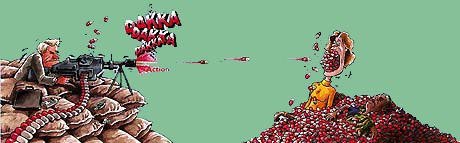
The drug companies target sections of the world population they think are particularly vulnerable to their hard sell. Women, children and the elderly population are in their gunsights and that means at least two-thirds of the world's population.
Women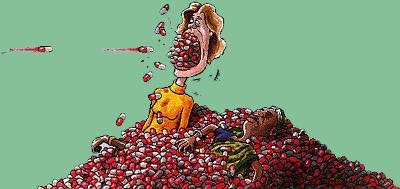
Women are a major target for drug companies, who encourage doctors to prescribe drugs - like tranquillizers or antidepressants - for problems which may be related more to women's status in society than to any actual illnesses.
In
India the company Sandoz recommends giving women with anxiety thioridazine, an
antipsychotic drug usually reserved for the treatment of severe psychoses such
as schizophrenia.
In
the West, hormone replacement therapy treatments for menopausal women have been
the biggest growth area: 30 per cent of post-menopausal women in the US and 10
per cent in Australia and Britain consume powerful hormones associated with an
increased risk of some forms of cancer.10 The
concept of hormone replacement is itself promotional. The hormones are not
missing: they do not need to be replaced.
Women in the Majority World are the target for invasive and dangerous
contraceptive treatments.
Children
Children have frequent but not usually serious illnesses which are part of a natural process that helps build up immunity. For many of these a wide range of drugs is not required. According to the WHO, two-thirds of all drugs used by children may be of little or no value. 11
From Peru, Pakistan and the Philippines come reports of claims by vitamin and
tonic manufacturers that their products improve children's intelligence. No such
drugs exist.
In
Brazil, a 1992 study of some 6,000 children aged three to four years found that
nearly 60 per cent had used one or more drugs in the previous two weeks and
nearly 10 per cent had been given medicine daily for a month or more. Loss of
appetite was the main reason for the use of the medicines.12
In
Malaysia and the Philippines pharmaceutical companies have used measures such as
free samples, promotional toys and children's clubs to target children directly.
The rationale behind selling unnecessary drugs for children is to start a habit of a lifetime.
The Elderly
Health problems are highly prevalent among the elderly, with 80 per cent having one or more chronic condition. But often these problems are only compounded by overprescription of drugs and by doctors relying solely on manufacturer's claims. Old people metabolize drugs differently and problems as diverse as incontinence and dementia can sometimes be drug-related.
In the US one out of every six people is over 60. But they consume one out of
every two sleeping pills, two out of every three antihypertensives, one out of
every three antidepressants and two out of every five gastrointestinal drugs.
The future: marketing disease and self-medication
There is a growing trend worldwide to shift the payment for medicine from state to consumer, by encouraging more self-medication. This means moving more products from prescription-only to over-the-counter classifications. In many countries of the South, prescription-only drugs are often freely available.
In 1992 the world market for over-the-counter medicines was estimated at $30.4 billion. By 2002 the figure is expected to climb to $43.4 billion (at constant dollars).13
Action
If you want no part in this future, you will have to be extra vigilant. Try to obtain the fullest information possible about any drug you may consider taking and weigh up the risks. Ask doctors about the medication they prescribe for you.
Two organizations that provide invaluable information for consumers and which lobby for the rational use of drugs are:
Health Action International HAI - Europe
Jacob van Lennepkade 334T
1053 NJ Amsterdam
The Netherlands
Tel: 31 20 683 36 84
Fax: 31 20 685 50 02
Malam - Medical Lobby for Appropriate Marketing Inc,
Malam HQ,
PO Box 172
Daw Park SA 5041, Australia
Tel/Fax: (618) 374 2245
Malam UK
13 Springhead Road
Thornton, Bradford
West Yorkshire BD13 3DA
Tel/Fax: (01274) 834512
Andrew Chetley has researched and published widely on health issues. Problem Drugs (Zed Books, London 1995), his latest book, is an extensive study of misused medicine.
References:
Chetley Andrew, "Pill Pushers, Drug Dealers," New Internationalist Issue 272, 1995 Chetley: Pill pushers
1
Scrip, No 2033 13 June 1995.2 World Development Report 1993 World Bank (OUP New York).
3 Scrip, No 2007 14 March 1995.
4 Glaxo Holdings PLC Annual Report and Accounts 1994 (Glaxo Holdings London).
5 The Wrong Kind of Medicine? C Medawar (Consumers Association and Hodder & Stoughton, London 1994).
6 Promoting Health or Pushing Drugs? A Chetley and B Mintzes (eds) (Amsterdam, Health Action International 1992).
7 Drug Labelling in Developing Countries US Congress, Office of Technology Assessment
(US Government Printing Office, Washington DC 1993).
8 World Drug Situation World Health Organization (WHO, Geneva 1988).
9 Problem Drugs A. Chetley (Zed Books, London 1995).
10 New England Journal of Medicine, 15 June 1995.
11 Drugs for Children G Rylance (ed) (WHO Copenhagen 1987).
12 'Long term use of medicines by Southern Brazilian children' JU Beria, Essential Drugs Monitor No 16.
13'The year of the switch' A P Charlish, Scrip, January 1995.
©Copyright: New Internationalist 1995